Live the Entrusted Life Through All Seasons
Sermon by Pastor Peter Lui
15 November 2026
Series: Living the Entrusted Life
Scripture: Philippians 4:10–13 | 1 Timothy 6:6–10
When the Bridge of Life Begins to Shake
Pastor Peter begins his sermon with a story about a young man standing before a narrow suspension bridge, uncertain whether he should cross.
Below him was a raging river. Strong winds blew against the bridge, making the journey appear dangerous.
A guide offered to lead him across.
The young man asked whether the bridge was safe. The guide assured him that although he could not promise the winds would stop or the bridge would remain steady, he would stay with him throughout the journey.
As they crossed, a powerful wind shook the bridge violently. Frightened, the young man cried for help.
The guide told him to hold tightly to the rope and keep his eyes on him.
Eventually, they reached the other side safely.
This story reflects our own lives.
There are seasons when everything seems stable. Our health is good, our family is doing well, our finances are secure and our plans are progressing.
Then suddenly, circumstances change.
We face unexpected difficulties, disappointments, financial pressures or uncertainty about the future.
When the bridge of life begins to shake, where does our confidence rest?
Pastor Peter reminds us that our security cannot depend entirely upon the stability of our circumstances.
It must rest upon the God who guides us through them.
Learning the Secret of Contentment
In Philippians 4:10–13, the Apostle Paul writes about learning to be content in every circumstance.
Paul knew what it meant to experience both abundance and need.
He had endured hardship, persecution and imprisonment. Yet his circumstances did not determine his contentment.
He declared:
“I have learned in whatever state I am, to be content.”
Paul’s confidence was not in what life could provide, but in the God who had entrusted life to him.
Pastor Peter explains that living the entrusted life through every season requires three things:
Surrender to God’s sovereignty.
Rest in God’s sufficiency.
Remain faithful in God’s stewardship.
Surrender to God’s Sovereignty
The first truth is that we must surrender our circumstances to God’s sovereign will.
Proverbs 3:5–6 reminds us to trust in the Lord with all our hearts rather than depend entirely upon our own understanding.
Pastor Peter observes that many people want God to bless their plans, but fewer are willing to surrender those plans to Him.
Surrendering to God involves three areas of our lives.
Surrender Our Plans to God’s Purposes
There is nothing wrong with making plans.
Planning is an important part of responsible stewardship.
We plan our careers, businesses, finances and families because we want to use our resources wisely.
However, there is a difference between making plans and demanding that life must unfold exactly as we expect.
An entrepreneur may carefully plan to expand a business, only to encounter unexpected setbacks.
An employee may work diligently towards a promotion but eventually be overlooked.
Surrender does not mean abandoning our responsibilities.
It means making plans diligently while remaining humble enough to accept God’s direction.
We can work towards our goals while praying:
“Lord, if You redirect my steps, give me the grace to obey.”
Surrender Our Problems to God’s Providence
In 1 Peter 5:7, believers are encouraged to cast their cares upon God because He cares for them.
God never promised that life would be free from trouble.
But He invites us to bring our burdens to Him rather than carry them alone.
Romans 8:28 reminds us that God works for the good of those who love Him and are called according to His purpose.
This does not mean every painful experience is good.
It means God can accomplish His good purposes even through difficult experiences.
When hardship comes, we should responsibly do what we can and pray about what lies beyond our control.
We do not need to allow fear to determine every decision.
Surrender Our Future to God’s Faithfulness
Jesus teaches in Matthew 6:33–34 that we should not become consumed by anxiety about tomorrow.
Each day has its own challenges.
Yet many people struggle to enjoy today’s blessings because they are overwhelmed by tomorrow’s uncertainties.
Some worry about retirement while still working.
Others worry constantly about their children’s future while missing opportunities to spend meaningful time with them today.
Pastor Peter reminds us to distinguish between responsible preparation and excessive worry.
We may not know what tomorrow holds, but we know the God who holds tomorrow.
When we surrender our future to Him, we can experience peace even when circumstances remain uncertain.
Rest in God’s Sufficiency
The second truth is that contentment comes from depending upon Christ.
Paul did not say that he was naturally content.
He said he had learned to be content.
This means contentment develops through experience, faith and dependence upon God.
Contentment Is Learned
Pastor Peter shares a personal testimony from his younger years.
As a student, he enjoyed debating and dreamed of becoming a lawyer.
He pursued that ambition, completed his legal studies and entered legal practice.
However, after less than a year, he sensed God’s call to surrender his career ambitions and enter ministry.
He had wanted to become a lawyer, but God had another direction for his life.
After serving as a preacher for several decades, Pastor Peter reflects that he has learned to be content with God’s calling.
This illustrates an important principle:
Contentment is not the absence of ambition. It is freedom from being controlled by ambition.
We can continue working towards meaningful goals without making our happiness entirely dependent upon achieving them.
When our plans are delayed or our expectations are not fulfilled, we can learn to trust God’s purposes.
Contentment in Plenty and in Little
Paul knew how to live with little and how to live with plenty.
Both circumstances test our hearts.
When resources are limited, we may become fearful, frustrated or resentful.
But when we have abundance, we face another danger: believing we no longer need God.
Pastor Peter points to Jesus’ parable of the rich fool in Luke 12:16–21.
The man accumulated great wealth and built larger barns to store his possessions. Yet he failed to recognise that his life ultimately belonged to God.
His wealth could not guarantee another day of life.
The lesson is that neither poverty nor prosperity should determine our spiritual stability.
When we have little, we should not assume God has abandoned us.
When we have much, we should not forget our dependence upon Him.
In every season, we must remember that God is our Provider.
Contentment Is Strengthened Through Christ
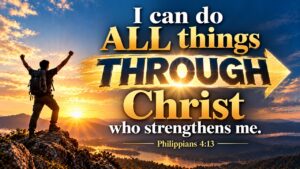
Philippians 4:13 is one of the most familiar verses in Scripture:
“I can do all things through Christ who strengthens me.”
Pastor Peter explains that this verse is often misunderstood.
Paul was not claiming that believers could achieve absolutely anything they desired simply by quoting Scripture.
The context is contentment.
Paul was declaring that Christ strengthened him to remain faithful whether he had plenty or little, whether he was comfortable or suffering.
For us, this means we can remain thankful when finances are limited.
We can remain faithful when our careers face uncertainty.
We can remain steadfast when life disappoints us.
And we can remain humble when success comes.
We do not accomplish this through our own strength alone.
Christ strengthens us.
The secret of contentment is not having enough possessions to satisfy every desire.
It is belonging to Christ, whose grace is sufficient for every season.
Remain Faithful in God’s Stewardship
The third truth is that everything entrusted to us must be managed faithfully for God’s glory.
In 1 Corinthians 4:2, Paul reminds believers that those entrusted with responsibility must prove faithful.
Pastor Peter explains that a steward is someone who manages what belongs to another person.
As believers, we are stewards of what God has placed in our hands.
Our time, talents, finances, opportunities and responsibilities ultimately belong to Him.
One day, we will give an account of how we have used them.
Faithful with What God Has Given
In Matthew 25, Jesus tells the parable of the talents.
Different servants received different amounts according to their abilities.
The master expected them to manage what had been entrusted to them responsibly.
Likewise, God expects us to use our gifts and resources faithfully.
Faithfulness is not measured simply by the size of our possessions or the importance of our position.
It is reflected in how we use our abilities, care for our families, serve others and practise generosity.
The question we must consider is:
“How well am I using what God has entrusted to me?”
Faithful Through Changing Seasons
Ecclesiastes 3 reminds us that there is a season for everything.
Life never remains exactly the same.
There are seasons of strength and seasons of weakness.
Seasons of success and seasons of disappointment.
Times when our work is recognised and times when nobody notices our efforts.
Yet our calling to faithfulness remains unchanged.
Colossians 3:23 teaches us to work wholeheartedly as though serving the Lord.
As employees, we should remain honest even when others compromise.
As employers, we should treat people fairly even when business becomes difficult.
As believers, we should continue serving God regardless of our circumstances.
Pastor Peter expresses this principle clearly:
Circumstances may change our assignment, but they do not change our allegiance.
Our commitment to Christ must remain constant through every season.
Faithful for God’s Glory
Ultimately, the purpose of the entrusted life is to glorify God.
Our intellect, abilities, possessions and opportunities are gifts that we hold in trust.
They are not given simply for personal comfort, recognition or accumulation.
They are opportunities to reflect God’s character through the way we live.
We glorify Him when we remain gracious under pressure.
When we conduct our business honestly.
When we are generous towards those in need.
When we remain hopeful during adversity.
And when we faithfully fulfil our responsibilities even when circumstances are difficult.
The question is not merely how much we have achieved.
It is whether our lives reflect the God we serve.
Final Reflection: Trust the Guide
As Pastor Peter concludes, he returns to the story of the young man crossing the suspension bridge.
The bridge shook.
The wind howled.
The journey was frightening.
But the guide remained with him.
Our lives will also experience changing circumstances.
Today we may enjoy success. Tomorrow we may face disappointment.
Today we may have more than enough. Tomorrow we may struggle to make ends meet.
But our confidence is not based upon everything going according to plan.
Our confidence rests in the God who remains faithful.
We cannot always choose the circumstances we experience, but by God’s grace, we can choose how we respond.
We can surrender what we cannot control.
We can rest in Christ’s sufficiency.
And we can remain faithful with everything God has entrusted to us.
So when the bridge of life begins to shake, remember the guide.
Keep your eyes upon the Lord.
Hold firmly to His promises.
And continue walking in faith.
May we learn to say, whatever season we are facing:
“Lord, I surrender what I cannot control. I will be content in Your sufficient grace, and I will remain faithful with all that You have entrusted to me.”
For the entrusted life is not defined by how much we possess, how much we achieve or how favourable our circumstances may be.
It is defined by how deeply we trust Christ and how faithfully we live for Him.
Trust and obey, through every season of life.